
What Does a Recipe Really Do?
The story of Sicilian orange salad, if a recipe can exist at all

The answer is not uncomfortable.
The answer is simple: a recipe does not always exist.
This happens often—very often—when dealing with the food of cucina povera, traditional peasant cooking.
Not because something is missing, but because nothing needed to be added.
In many simple dishes of the past, the ingredients themselves were the recipe.
The product—fresh, seasonal, available—contained everything: flavor, balance, meaning.
There was no fixed sequence.
No technique to codify.
Only a shared, unspoken knowledge shaped by time and repetition.
Perhaps this is why it feels distant to us today.
In a world of ultra-processed food, intensive agriculture, and increasingly conceptual or molecular cuisines, we have gone looking for “experience” far away from the raw material.
We have multiplied transformations, narratives, and structures.
And yet, the combinations that still work—always—are those shaped by time, not by invention.
They endure because they are essential.
Because they are born from the meeting of one ingredient, one place, and one season.
Sicilian orange salad belongs to this world.
A world where the recipe is not written because it already lives inside the ingredient.
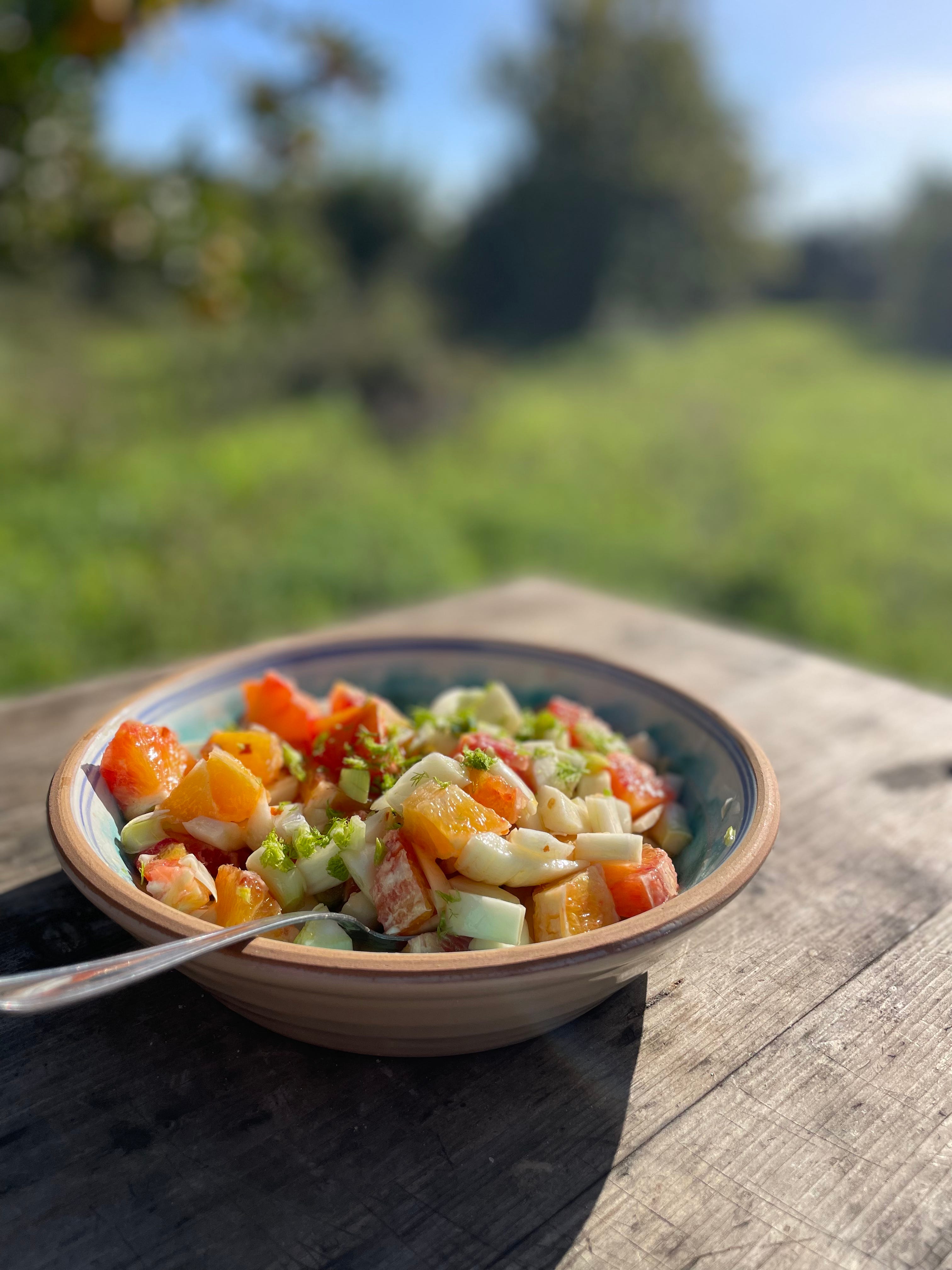
The Orange Before the Dish
Literature, orange blossom, landscape
When we fail to find orange salad in traditional recipe books, there is only one other place left to look.
We find it in literature.
Not because literature tells us how to prepare it—
not as an ingredient list,
not as a sequence of steps,
not as a codified recipe.
We find it instead in ways of living, in gestures, in rhythms, in what is considered so obvious that it no longer needs to be explained.
In Sicily, the orange exists long before it becomes a dish.
It exists as landscape,
as scent,
as a color that permeates storytelling.
In Sicilian literature, oranges appear everywhere—but almost never as a preparation.
They are not explained, because they do not need explanation.
They are part of the human environment before they are part of the kitchen.
In the work of Giuseppe Verga, citrus groves often become tools of social critique: symbols of labor, exploitation, and inequality.
In Verismo literature, the fruit is never innocent.
It reveals who owns the land and who works it, who profits and who endures.
In Elio Vittorini, oranges become a marker of identity—a link between the individual and a deep, resistant South, both archaic and profoundly human.
With Andrea Camilleri, oranges and their scent belong to daily life, to sensory memory, to what remains unsaid.
They are so obvious that they no longer need to be named as food.
In the writing of Vincenzo Consolo, citrus fruit often becomes metaphor: a wounded Sicily, crossed by history and contradiction, yet still capable of beauty and resistance.
And even in Gesualdo Bufalino, oranges turn into language itself—sensory excess, literary matter.
Orange blossom—zagara—another word of Arabian influence, perfumes these pages before it ever reaches the kitchen.
It is not an ingredient; it is an atmosphere.
This is why oranges in Sicily need no explanation.
They belong to the moral landscape.
They grow outside the house.
They are harvested in winter.
They mark time.
Eating and cultivating are not separate acts.
They are the same gesture, seen from different angles.
And this is why orange salad never needed to become a “recipe”:
it was a cultural certainty.
Why There Is No Recipe
(and why that’s perfectly fine)
Orange salad was not born as a “dish,” but as a way of eating fruit.
Raw.
In season.
Untransformed and just well combined :)
The idea of using fruit in a savory context—treating it as a dish rather than dessert—likely arrived with the Arab world, which introduced a different relationship between sweet and savory, raw and seasoned, into the Mediterranean.
But in Sicily something decisive happened:
the product became the recipe.
Basic combinations became more like rules, this is why so difficult to get out of their taste for Italians in general.
The History of the Orange
Centuries, empires, and a language that remained
The history of Sicilian orange salad is, in reality, the history of the orange itself—and of the centuries that shaped the island.
Oranges arrived in Sicily with the Arab domination, beginning in the 9th century and lasting until the 11th century.
The Arabs did not simply bring a fruit: they introduced an entire agricultural system.
Irrigation techniques, water management, gardens, and a new way of thinking about cultivation transformed the landscape permanently.
What they brought first was the bitter orange—highly aromatic, resilient, and better suited to perfumes, medicine, and preserves than to being eaten raw.
For centuries, this was the dominant citrus fruit on the island.
Sweet oranges came much later.
They originated in East Asia, traveled through the Islamic world, and entered Europe through Mediterranean and Iberian trade routes.
From the 15th and 16th centuries onward, Portuguese merchants played a decisive role in spreading sweet oranges across Europe, following the same maritime networks that connected Africa, Asia, and the Atlantic world.
This is why, in Sicily—and only in Sicily—the orange is still called portugal, partugalla, or purtuallu in local dialects.
And this detail matters.
Sicily is the only region in Italy that experienced a long and deep Arab domination.
The rest of the peninsula did not.
This linguistic trace survived only where that history was lived fully and continuously.
The same phenomenon exists in Andalusia, the other great Mediterranean region shaped by Arab rule.
There too, the word for orange preserves the memory of those trade routes, those empires, those centuries of exchange.
With the arrival and diffusion of sweet oranges, everything changed:
the fruit became everyday food,
food became gesture,
gesture became habit.
And habits, once again, do not need recipes.
They need time.
They need land.
They need memory.
Agriculture, Water, Community
In the twentieth century—especially from the 1980s onward—Sicilian agriculture changed profoundly.
Access to water through drilled wells allowed for larger and more intensive cultivation.
Communities increasingly organized themselves around citrus groves.
The orange became even more deeply embedded in daily life—not just in the economy.
This only reinforced what was already true:
orange salad is not a special dish.
it is a natural consequence.
If We Really Must Give a Recipe
And so, if someone insists and asks:
“But how do you actually prepare orange salad?”
The answer might be this:
You prepare it with the sun.
With winter sun.
With cold nights and bright days that allow anthocyanins to develop, giving Sicilian oranges—especially in the eastern part of the island—a depth of color and complexity that cannot be replicated elsewhere.
You prepare it with climate.
With soil.
With time.
Everything else—the knife, the oil, the salt, chilly flakes, onions, black olives, and fennel…. just a detail.
Because in the end,
orange salad is not a recipe.
It is a story you can eat
Watch the preparation on Instagram
.
Very thoughtful! It made me think that we also try to make recipes for our lives. Get your child into an exclusive school, make them be star athletes, have them go to Harvard Business School, then all will be well. Or, move to Texas and marry a rich man and have two children and a beautiful house. But of course life doesn’t work that way. Yet we still keep writing recipes!